
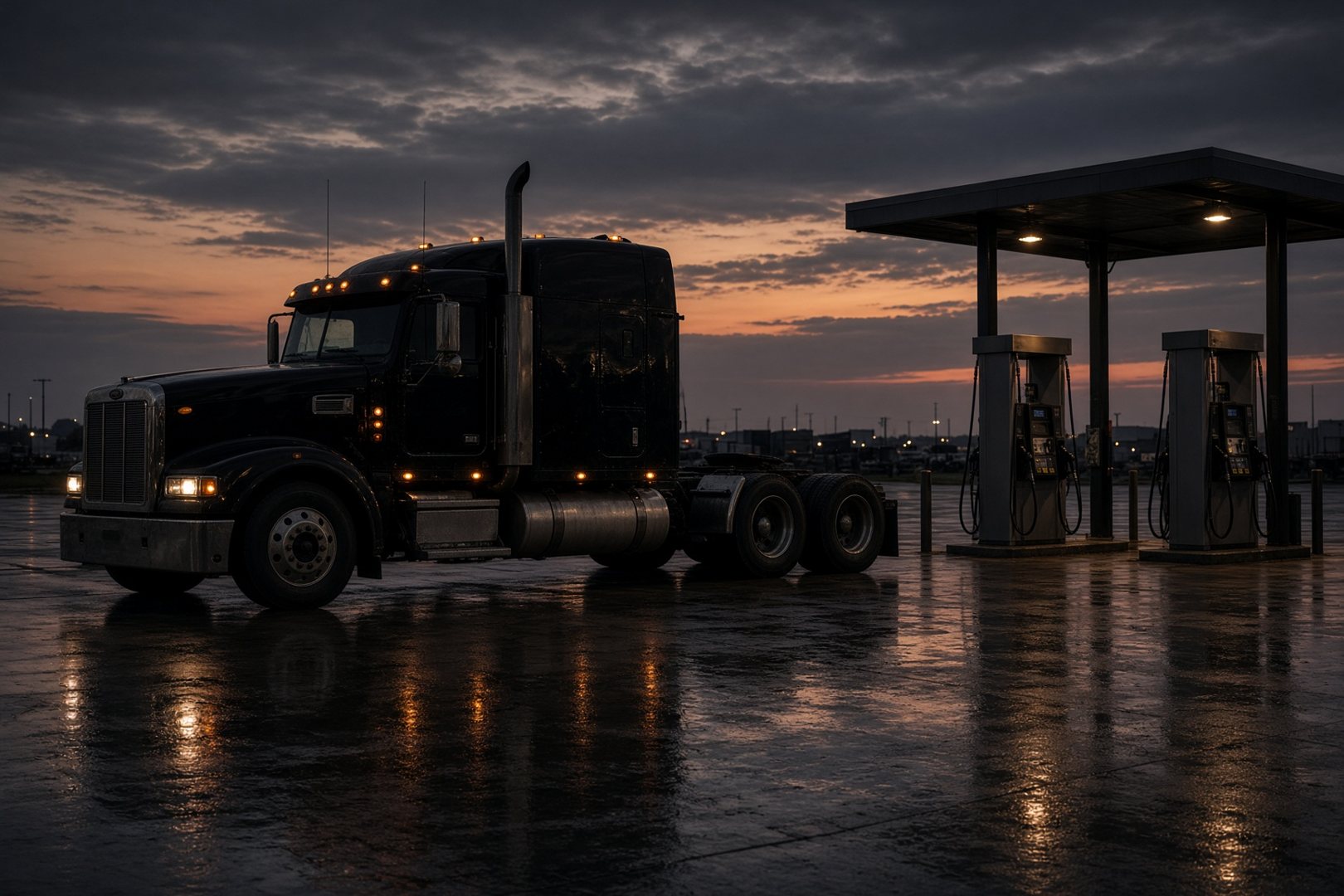
General information for carriers. This article is not legal, tax, accounting, or regulatory advice.
Fuel is a routing decision, not only a price decision. The pump with the best number on a sign can sit twenty minutes off the lane, behind a line, or in a lot that turns a day cab into a puzzle. If that stop spends the appointment you needed, the savings are not savings. They are a late arrival you will explain for free. Plan the stop the way you plan the reload: where the truck will be, how long the stop really takes, and what time still has to be true at the next door.
Start from the appointment and walk backward. The receiver window is the fixed point unless you have already moved it in writing. Subtract the drive that remains after the stop, not the drive that a map shows with no interruption. Add the minutes you have actually seen at that location: the line, the exit, the slow lot, the time it takes to get back to speed. If the math only works when every light is green, the stop is in the wrong place. Move it earlier on the lane, or buy fuel where the path already goes, even if the price is a few cents higher. Cents are visible. A missed window is a different bill.
Match the stop to the hours, not to a wish to fill the tanks. A driver who is close to the end of the driving day does not need a scenic plaza. They need a stop that does not create an extra problem before the reset. A driver who has time and a long stretch ahead can choose the price more freely. Write that difference into the plan so the person booking the freight and the person buying the fuel are not optimizing two different days. The truck has one clock. The plan should have one clock.
Watch the stops that always run long. Some locations look convenient on a map and routinely add half an hour you do not bill. If the same plaza shows up whenever a delivery goes from comfortable to tight, take it off the default list for loads with a hard window. Keep it for loads with slack. A preference list for fuel is as practical as a preference list for lanes. It does not have to be complicated. Three places you trust and three places you avoid will change more weeks than a perfect national ranking you never have time to check.
Tell the broker early if the only way to make the door is to skip a stop you actually need. Running the tank down to protect a window is not a clever plan if the next stretch cannot be done safely. Say what is true: the arrival holds if the stop happens here, or the arrival moves. Most customers would rather move a door than hear about a truck that did not arrive. You do not need a speech. You need a revised time and a reason that matches the route. Then put the note in the load file so the day has one story.
On the weekly review, look at fuel the way you look at empty miles. Which stops protected a window. Which stops were chosen for price and still made the door. Which stops cost a fee, a reschedule, or a tired scramble. The goal is not the lowest gallon on the screen. The goal is a gallon that leaves the appointment intact. Carriers who plan the stop before they roll stop arguing with the clock at the last exit. The appointment was the point of the load. The pump is there to serve it.